A site diary is the architect’s daily record of what happened on site: who was there, what was built, what was instructed and what went wrong. It is easy to neglect during a busy construction stage and impossible to rebuild afterwards. This guide compares what German, UK and US practice expect from the architect’s site records, sets out what a good entry contains, explains how long the record has to last and shows where AI can help – and where the architect must stay in charge.
Why the site diary matters more than it seems
During construction, the architect’s attention is on site visits, contractor questions, valuations and the client. The diary is often written in the evening from scribbled notes, phone photos and memory – or not at all. Nobody notices the gap until months or years later, when a delay claim, a defect or a disputed variation needs a record of what actually happened on a particular day.
At that point the site diary is often the only contemporaneous record. Minutes record what was agreed in meetings; the diary records what was seen, instructed and left undone on site.
What German, UK and US practice expect
The obligation is framed differently in each country, but the expectation is the same: methodical, contemporaneous records of site visits.
| Country | Source | What it asks of the architect |
|---|---|---|
| Germany | HOAI fee scale, Annex 10, work stage 8 (site supervision) | “Documentation of the construction process (for example a construction diary)” as a basic service; stage 8 carries 32 % of the building fee [1][2] |
| United Kingdom | RIBA Plan of Work, Stage 5 checklist | “Keep methodical records of all site visits and results of all tests witnessed or reported” [3] |
| United States | AIA G711–2018 Architect’s Field Report | A concise record of site visits; for a full-time representative, a daily log of construction activities [4] |
What happens when the diary is missing
A German appeal court case shows the consequence clearly. In 2005 the Higher Regional Court of Celle (14 U 68/04) held that the architect’s site diary records the contractors’ work and deliveries, their staffing and the conditions on site, and that it serves as evidence for later disputes – it is not a private memory aid. Because the architect had not kept it fully and it could no longer be reconstructed after completion, the court reduced the fee for the supervision stage [5].
The case was decided under the earlier version of the HOAI, and fee rules differ elsewhere. The point travels well: if site supervision is part of the appointment, the client is entitled to a record of it. This is general information, not legal advice (as of October 2026).
What to record in each site diary entry
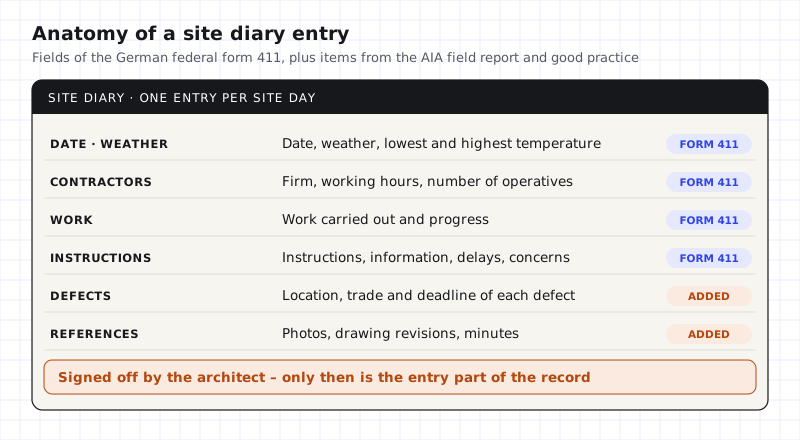
The German federal government’s standard construction diary form (form 411 of its procurement handbook) is a useful checklist because it is short [9][10]. Combined with the items the AIA field report focuses on – progress, quality, deviations from the contract documents and the schedule, defects [4] – a complete entry covers:
- date, weather and temperature range
- contractors on site, their working hours and number of operatives
- work carried out and progress against the programme
- instructions given, information handed over, additional orders
- delays, disruption and concerns raised – by whom and when
- defects observed, with location, trade and deadline
- references to photos, drawing revisions and meeting minutes
- sign-off by the person responsible for site supervision
Site diary, daily report and meeting minutes
Three records are easily confused: the architect’s site diary, the contractor’s construction daily report and the minutes of site meetings. Keeping them apart avoids gaps and duplicated effort.
| Record | Kept by | What it covers |
|---|---|---|
| Site diary / field report | Architect or their site representative | The site as seen by the supervisor: weather, contractors, work, instructions, delays, defects |
| Contractor’s daily report | The contractor, where the contract requires it | The contractor’s own work, labour and plant |
| Site meeting minutes | Usually the architect or contract administrator | Decisions, responsibilities and deadlines agreed in meetings [3] |
How long a site diary has to last
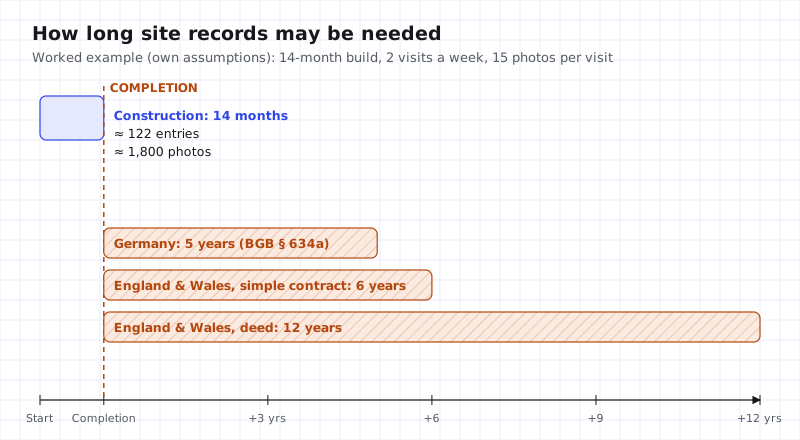
Disputes rarely arise during construction. In Germany, claims for defects in a building – and in the planning and supervision services for it – are time-barred after five years [6]. In England and Wales, an action founded on simple contract cannot be brought after six years, and an action on a deed (a specialty) after twelve years [7][8]. In the US, limitation and repose periods vary by state.
Worked example (our own assumptions, not measured data): a 14-month new-build, visited twice a week, with about 15 photos per visit. Fourteen months is roughly 61 weeks, so the project produces about 122 diary entries and more than 1,800 photos. Under an appointment signed as a deed in England, each of those entries may need to be found and understood twelve years after the cause of action arose.
Common site diary mistakes
Most problems are habits, not knowledge gaps:
- Writing entries at the end of the week, when details have gone and conflicts with the contractor’s daily reports go unnoticed.
- Photos without context – no date, location or element – which prove little.
- Verbal instructions and delays that never reach the diary.
- Gaps when the site architect is on leave and nobody covers the diary.
- Records scattered across phones, e-mail and folders, impossible to assemble years later.
- Photos of identifiable workers taken without any data protection rules.
Where AI helps with the site diary – and where it does not
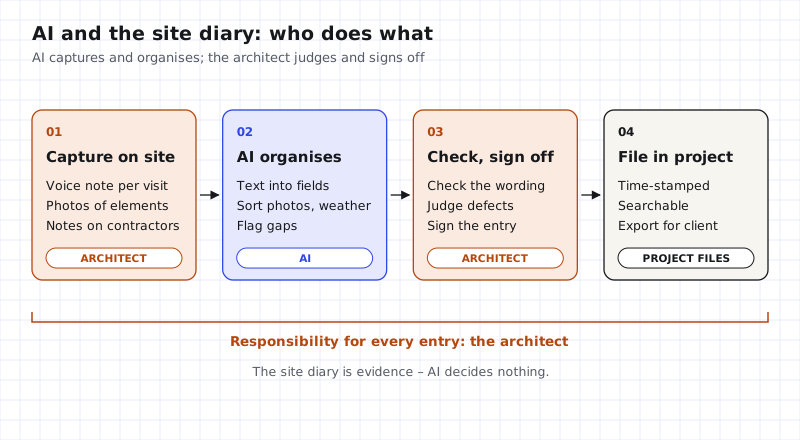
AI is already used in practices mostly for writing: in the German chamber survey of 2025, 58 % of AI users said they use it often or very often for texts such as minutes [11]. The site diary is close to that experience, with one difference: it is evidence. AI can capture and organise; it must not decide.
| Task | What AI can do | What the architect does |
|---|---|---|
| Voice notes on site | Transcribe and sort them into the fields of the entry | Check the wording, especially for instructions and defects |
| Photos | Sort photos by date, room and element and attach them | Confirm the selection and the location |
| Weather | Add weather data for the site and the day | Compare it with what was observed |
| Completeness | Flag missing days, contractors or open defects | Close or explain the gaps |
| Notices | Draft a note on a delay or defect | Assess, decide and sign |
Photos, personal data and AI services
Under the GDPR, a photo of an identifiable person is personal data – and people can be identified by clothing, posture or the time and place of the photo, not only by their face [12]. Site photos can usually rely on legitimate interest, but the people shown must be informed [12]. The simplest office rule: photograph building elements, not people.
Before an AI service processes voice notes and photos, check where the data is processed, whether the provider uses it to train its models, and whether a data processing agreement is in place (Article 28 GDPR) [13]. In the EU, the AI Act has also required organisations that use AI at work to ensure sufficient AI literacy of their staff since 2 February 2025 [14].
How we help
Kernmoment sets up AI for site supervision so that it fits the practice’s templates, project folders and rules: a site diary structure based on the federal form, voice notes and photo sorting with a check step, filing in the project and a clear sign-off by the architect. The work stage page on AI in construction supervision shows how this looks in practice.
Risks and limits
A digital site diary with AI does not replace site supervision:
- Whether a defect exists, whether a delay must be notified and whether an instruction is needed is the architect’s judgement, not the AI’s.
- An entry becomes part of the record only once the architect has signed it off; later changes should remain visible.
- Contractual documentation requirements, for example from public clients, take precedence and may go beyond the fee scale or the standard forms.
- Questions of liability, evidence and limitation belong with a lawyer; data protection questions with your data protection officer.
Site diary: quick answers
What should an architect’s site diary include?
Date, weather, contractors and labour on site, work done and progress, instructions given, delays and concerns, defects with location and deadline, references to photos and minutes, and the architect’s sign-off.
Is a site diary a legal requirement for architects?
In Germany, the HOAI lists documentation of the construction process, for example a site diary, as a basic service of site supervision, and a court has reduced a fee where it was missing. In the UK and the US it is expected professional practice through the RIBA Stage 5 checklist and the AIA field report. Not legal advice.
How long should a site diary be kept?
At least as long as claims can be brought: five years after acceptance in Germany, six years for a simple contract and twelve years for a deed in England and Wales. US periods vary by state.
Can a site diary be kept digitally?
Yes. None of the sources requires paper; a site diary app or a structured template in the project folder both work. What matters is that entries are made promptly, signed off by the responsible person and stored so that later changes remain visible.
Can AI write the site diary?
AI can transcribe voice notes, sort photos and point out gaps. The architect has to check, sign off and take responsibility, because the diary is evidence.
Sources
- HOAI 2021 (German fee scale for architects and engineers), Annex 10, work stage 8, basic service e)
- HOAI 2021, Section 34(3): weighting of work stages for buildings (stage 8: 32 %)
- RIBA Publishing (2020): Stage 5 Manufacturing and Construction checklist
- AIA Contract Documents: Summary – G711–2018, Architect’s Field Report
- Higher Regional Court (OLG) Celle, judgment of 11 October 2005, 14 U 68/04 (in German, via IWW)
- German Civil Code (BGB), Section 634a: limitation of claims for defects (five years for a building)
- Limitation Act 1980, section 5: actions founded on simple contract
- Limitation Act 1980, section 8: actions on a specialty
- German federal procurement handbook (VHB Bund), 2017 edition, form 411 “Bautagebuch” (construction diary)
- VHB Bund, form 411 “Bautagebuch” (template, 2008 edition)
- Bundesarchitektenkammer (German Federal Chamber of Architects): professional survey 2025, report on artificial intelligence
- Independent Centre for Privacy Protection Schleswig-Holstein (ULD): photos and webcams under the GDPR (May 2025, in German)
- Regulation (EU) 2016/679 (GDPR), Article 28 Processor
- Regulation (EU) 2024/1689 (AI Act), Article 4 AI literacy