
Rethinking indoor quality – architecture and IoT working together
We spend over 90% of our time indoors – in homes, offices, schools, care facilities, or public buildings. In doing so, we are exposed daily to numerous environmental factors that directly influence our health and well-being: such as air quality with parameters like CO₂, VOCs, fine dust or humidity, as well as lighting conditions and noise levels.
These factors have a proven impact on concentration, mood, sleep quality, cognitive performance, and overall physical well-being. Especially sensitive user groups such as children, the elderly, or professionals working indoors benefit significantly from targeted optimization.
To truly achieve high indoor quality, it requires the interaction of two complementary components: on one side, architecture, which creates a stable foundation for a healthy indoor climate through material selection, spatial structure, and construction elements. On the other side, optimized control of dynamic environmental factors – such as smart climate devices, lighting systems, or air purifiers that automatically adapt to current conditions.
This is exactly where our approach at KernMoment begins:
We combine architectural know-how with intelligent technology – for spaces that actively adapt to changing needs and remain sustainably healthy.
Which factors are optimized?
At KernMoment, we take a holistic view of indoor quality. For us, this means: every relevant environmental factor is considered both architecturally and technologically. Only the interaction between spatial design and intelligent real-time control ensures long-term healthy and performance-enhancing conditions – in care facilities, schools, offices, or private homes.
How do architecture and IoT contribute to optimization?
At KernMoment, we integrate architecture and technology from the very beginning. Our foundation: architecture provides the material basis for healthy spaces, while our internally developed IoT system dynamically responds to changing conditions. Only through their interaction can an environment actively adapt — to time, usage, and individual needs.
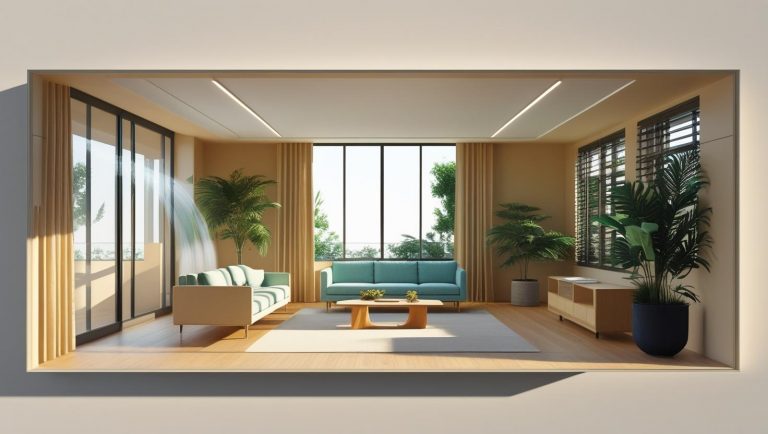
Already in the design phase, we lay the foundation for high indoor quality:
We select materials with positive effects on air, light, and acoustics.
We organize spaces so that air flows, daylight is guided, and sound is specifically dampened.
We integrate structural elements such as acoustic ceilings, light guidance, or passive ventilation concepts.
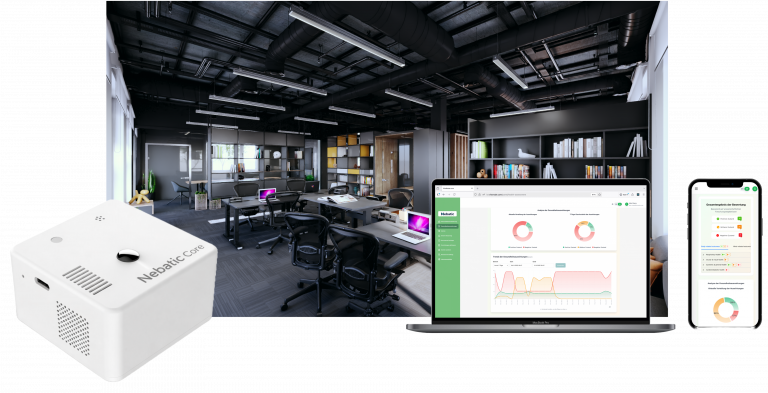
We complement this stable architectural foundation with a finely tuned, sensor-based system:
Our sensors continuously record CO₂, VOCs, temperature, humidity, particulate matter, light, and noise.
The values are analyzed in real time to immediately detect deviations from optimal conditions.
Connected devices such as fans, air purifiers, lighting systems, or acoustic elements are automatically activated.
Synergy makes the difference
Static indoor quality alone is no longer enough – and pure automation without an architectural foundation remains superficial. We combine both: spatial concepts that have long-term impact, and intelligent systems that respond flexibly. The result is an environment that is not only designed but also understood and actively controlled — for better health, more comfort, and greater efficiency.
What are the key outcomes?
Through the targeted combination of architectural spatial quality and intelligent real-time control, we at KernMoment achieve central impacts: people live and work healthier — and buildings operate more efficiently, safely, and sustainably.
Health
Healthy spaces through architecture and intelligent control
Health doesn’t just happen on its own — it needs good quality and dynamic adaptation. That’s why we design spaces that are planned for health from the beginning — and automatically adjust to changing conditions.
Fresher air through CO₂ regulation
Architecture ensures natural air circulation – our sensors complement this with automatic ventilation before the air becomes “stale.” This helps maintain concentration and prevents headaches, fatigue, or dizziness.
Less strain on the respiratory system thanks to fine dust reduction
Low-dust materials, clean zoning, and digital fine dust detection work together – making invisible pollution measurably lower and the air noticeably cleaner.
Fewer pollutants thanks to VOC monitoring
Emissions from paints, furniture, or cleaning agents can be reduced through construction – but not completely avoided. Our sensors immediately detect elevated levels and automatically trigger ventilation or air purification.
Increased well-being through stable temperature conditions
Material selection and spatial layout help to buffer temperature fluctuations. Our control systems respond precisely to changes – for restful sleep, improved concentration, and thermal comfort.
Healthy indoor climate through regulated humidity
Moisture-regulating materials and smart ventilation concepts lay the foundation – our sensors keep humidity in the ideal range. This protects the skin and mucous membranes and prevents mold growth.
Stable internal rhythms through good lighting
Daylight is purposefully shaped through room depth, window size, and reflection. Our lighting control automatically adjusts artificial lighting – for better mood, focus, and sleep quality.
Less stress through controlled acoustics
Sound-absorbing ceilings, zoning, and materials reduce disturbances through architectural design. Our system additionally responds to noise peaks – visually, acoustically, or automatically. This creates more calm in everyday life.
Building operations
More efficient, safer, and more sustainable through architecture & technology
A well-functioning building requires thoughtful planning and intelligent systems. At KernMoment, we pay attention to both levels — to conserve resources, reduce risks, and reliably meet regulatory requirements.
Lower operating costs through reduced energy use
Thermal insulation, daylight use, and zoning reduce base consumption. Combined with automatic control of lighting, ventilation, and heating, operating costs can be significantly lowered.
Fewer maintenance costs through early problem detection
Material behavior, humidity, or pollutant accumulation become visible – both architecturally and digitally. This helps prevent damage, optimize maintenance, and reduce follow-up costs.
Greater planning security through compliance with legal standards
Our solutions make it easier to comply with air quality, noise protection, and energy regulations – through targeted planning and automatic documentation. This supports certification processes and builds trust among users and authorities.
Learn more about devices and subscription plans from our group company Nebatic
How do we proceed?
High-quality indoor optimization requires structure. That’s why at KernMoment we follow a clear process – from the initial analysis to long-term fine-tuning. Each step delivers measurable insights and clear decisions.
Analysis phase: on-site and digital assessment
We begin with a combined room analysis – architectural and sensor-based. We assess the structural conditions, materials, lighting, and acoustics. In addition, we use our IoT sensors to measure current room values such as CO₂, temperature, humidity, noise, and light.
Concept development: architecture meets system logic
Based on the analysis, we develop a tailored optimization concept. We combine architectural adjustments with the integration of our IoT system. The goal is a coherent overall concept that functions both architecturally and technically – adapted to usage, room functions, and users.
Implementation: install technology, adapt spaces
In this phase, we put the overall concept into practice – both architecturally and technically. On the architectural side, targeted measures may be necessary, e.g. retrofitting acoustic elements, adjusting light guidance, or making smaller modifications. At the same time, we install our IoT system: sensors, data processing, and automatic control are set up and tested. Everything is coordinated – for seamless interaction between spatial structure and digital intelligence.
Optimization cycle: real-time data & ongoing fine-tuning
After implementation, the continuous optimization process begins. Our platform continuously analyzes room data, detects changes, and reacts automatically. In addition, we provide periodic evaluations and recommendations for fine-tuning – for lasting quality and transparency in building operation.